




There’s a question we’ve been hearing frequently lately: “Is it too late to enter Athens?”
The short answer: no. But it gets a bit more complex—because the market has changed shape. Those looking for the Athens of 2017 won’t find it. What can be found in 2026 is a market that has proven itself, with entry points that still make sense, and with several specific factors for this year that are worth understanding before making a decision.

A Market That Has Matured and Why That’s Actually Good
In 2025, property prices in Athens rose by 6.2% (according to Bank of Greece data). This sounds less exciting than previous years: 2023 and 2024 recorded 14% and 9% respectively. But there’s a difference between a market heating up from speculation and a market growing on real demand. The Athens of 2026 is the latter.
And now for the surprising comparison: when comparing Athens to other European capital cities in the same year, Berlin grew only 3.4%, Madrid 5%, Lisbon 2.7%, Paris 1.3% (source: Knight Frank, 2026). Athens outpaced them all—and still trades at much less. Average price per square meter in Athens is still less than half the price of Madrid.
What Drives Demand and Why It’s Not Going Anywhere
The mistake many make is thinking of Athens only as a “tourism market.” That’s true but partial.
Yes, 37 million tourists came to Greece in 2025 with revenues of approximately €20 billion (Bank of Greece). Athens has long ceased to be a stopover—it’s a growing tourist destination. But what creates real stability is the demand that continues even when tourists return home.
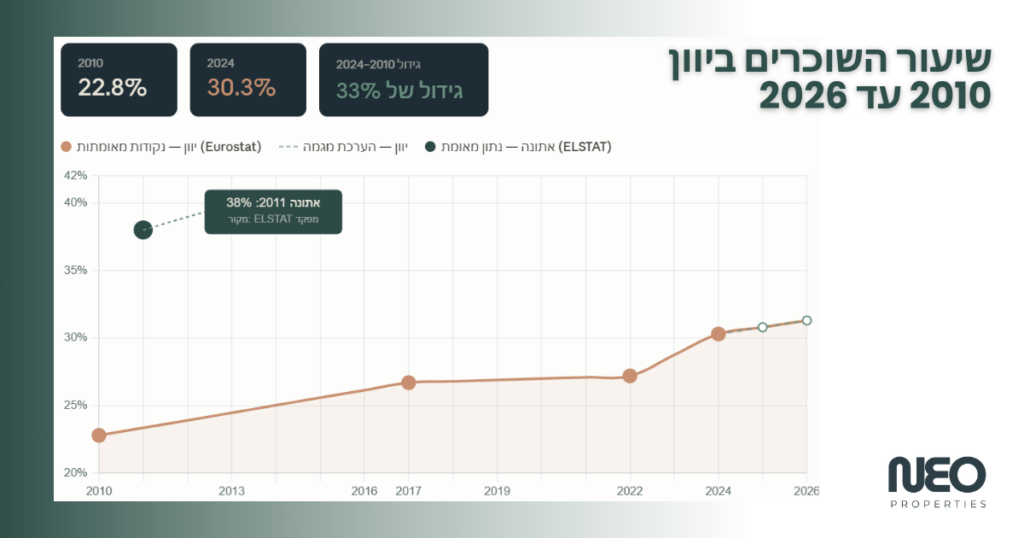
The rental rate in Greece rose from 22.8% in 2010 to 30.3% in 2024. One-third of the population rents, and the number is rising.
In Athens itself, the number is much higher—according to the ELSTAT census, already in 2011 the rental rate in the Athens municipality stood at 38%, and in certain neighborhoods reached 50%. Since then, the market has only added pressure.
Rental prices in central Athens rose 7.6% in the past year (Spitogatos, 2025).
This is not a bubble—it’s structural pressure on a market that hasn’t built enough housing units in the past decade.
In practice, those holding a small, properly managed apartment in a good location with good access to public transportation
are at a point where two sources of demand work together: short-term tourism during the season, long-term rentals the rest of the year. This flexibility is an advantage that doesn’t always receive proper emphasis. Especially in a period where we’ve seen a global pandemic and other crises pass before us.
What We’re Seeing on the Ground in 2026
The next wave of appreciation won’t come only from general housing prices. It will come from specific neighborhoods receiving a catalyst.
The pattern we’re seeing repeats itself: a neighborhood with a strong foundation, stable population, good metro accessibility, existing services, that receives a major urban development project.
A government or public project that changes the economic character of the area.
An example happening right now: on an old industrial site in south-central Athens, the city’s new government complex is being built,
a project spanning approximately 98,000 sq m that will consolidate government offices, parks, and public spaces. A project that will create stable employment, attract a working population, and increase demand for long-term rentals in the area—exactly the kind of demand an investor wants.
Those who identify these signals before they make headlines gain an attractive investment with returns that exceed the market average.
Want to hear about our new project near the government complex? Click here.
So Why Invest in Greece Specifically in 2026?
The tax treaty. Greece and Israel signed a double taxation treaty back in 1995, and its meaning is simple: on real estate profits in Greece—rentals and sales—taxes are paid in Greece only, not in Israel. The acquisition tax stands at only 3.09%, and capital gains tax on real estate is effectively suspended until the end of 2026. Those closing a deal this year enter a transparent and familiar tax framework.
The euro exchange rate. The euro is trading at relatively favorable levels compared to the historical average against the shekel. Purchasing now is also a position on currency recovery without taking additional currency risk beyond the real estate itself.
Entry prices are still attractive. Athens has risen 86% since the 2017 low, but is still below half the price of most European capitals. If the gap closes, even partially, those entering in 2026 will benefit. If not, they still receive rental yields not found in Israel. Not to mention that for the price of a down payment in Israel, you can acquire a working, income-generating property in Athens.
What to Check Before Entering
A growing market doesn’t mean a market without complexities.
Short-term rental regulation is changing. Athens banned new Airbnb licenses in three central districts, and the restriction was extended until the end of 2026. The number of short-term rental apartments in central Athens nearly doubled the hotel capacity in the area, leading to a housing crisis and sharp increase in rent for local residents.
The government is trying to balance tourism with a livable city, and is even offering a three-year income tax exemption for property owners who switch from short-term to long-term rentals.
Associated costs stand at approximately 8-10% of the property price—
lawyer, notary, appraiser, registration. These are figures that enter the calculation in advance, not afterward.
Remote management is part of the equation. Professional local management typically costs 10-15% of rental income.
Still attractive, but it’s worth calculating net yield, not gross.
In Summary
2026 doesn’t offer the opportunity of a first year in an emerging market. It offers something else—
a market that has proven itself, with real structural demand, with specific timing factors for this year, and with appreciation potential for those who know how to identify the right neighborhoods before everyone else.
It’s not suitable for everyone. But for those asking the right questions—the answers in the Greek market are among the best currently available in Europe.
Do you have questions about the market and how to invest? The Neo Properties team is available for a conversation.
Frequently Asked Questions
Is it still worthwhile to invest in Greek real estate in 2026? Yes, but differently than in 2019. The market is more mature, entry prices have risen, but structural demand is strong and stable. The focus has shifted from “buy everything” to “buy right”—location, neighborhood, rental strategy.
What’s the difference between investing in Athens and investing in Israel? Average rental yield in Israel stands at approximately 2-3% gross. In Athens, with a properly managed property, 5-7% net is a realistic target and there are properties that achieve even higher percentage yields. Additionally, entry prices are significantly lower and allow full market entry at an amount that in Israel is only a down payment for a property.
How do you identify a neighborhood with potential? The signals we check: approved public development projects, accessibility to public transportation, existing long-term rental demand, and a stable population, not just tourism-based.
How much does it cost to enter the Greek market? It depends on the area and type of property. In neighborhoods with high demand for long-term rentals, entry prices start at €110,000 for a new property, furnished and ready for rental. Beyond the property price, it’s important to plan for an additional 8-10% for associated costs.
What are the main risks? Regulatory changes in short-term rentals, incorrect property selection, and unprofessional remote management. All three can be mitigated with proper due diligence and professional guidance.